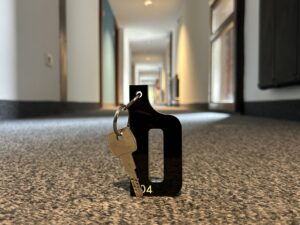
Hotel Boite is a place out of time, surrounded by the woods that rise on the slopes of Antelao, in a small mountain village. In an age when the hospitality industry standardises welcome through key cards and automated entry, “il Boite” has deliberately chosen not to move towards electronic room access, but to keep those beautiful keys with their heavy, tactile, substantial keyrings.
This decision comes from a profound act of respect — from care and love for the architectural and intellectual legacy of Edoardo Gellner, the architect who, under the patronage and enlightened vision of Enrico Mattei, conceived the entire Villaggio ENI of Corte di Cadore between the late Fifties and the Sixties.
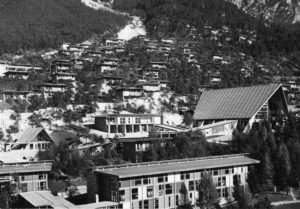
To understand the value of a key at Hotel Boite, you have to step into the philosophy of the Gesamtkunstwerk — the total work of art that, for Gellner, finds its fullest expression in the Villaggio di Corte di Cadore. Here he did not limit himself to designing the concrete volumes, the roofs and the structures; he personally designed every single visual and functional micro-element. From the lamps to the furniture, down to the most infinitesimal technical details: everything had to answer to a rigorous geometric and chromatic harmony, studied to blend organically with the surrounding landscape.
In this context, replacing the old locks with plastic badge readers or digital keypads would mean breaking the philological continuity. The room doors, with their wood grain and their original structural metal components, have been preserved in their integrity. Because every element in the hotel answers to specific rules, and the handles are no exception: made in satin-finish metal alloys, with the clean, geometric lines typical of organic modernism, they are maintained to preserve that analogue gesture — solid and secure — so characteristic of the great architectural craftsmanship of the twentieth century. In the golden years of the Villaggio ENI, just as today, the key is the heart of a precise ritual of welcome.
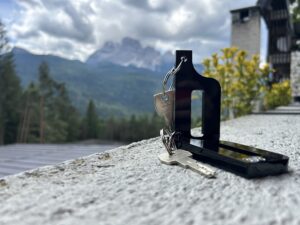 The Hotel Boite keyring, heavy and tactile, acts as a physical bond between guest and building: collected at reception in the morning before excursions and handed back in the evening, it encourages human exchange, the telling of the day, and the sociability that Enrico Mattei so strongly wanted for his company and holiday community.
Today, holding that same key in your hands is not an anachronism.
It’s the beginning of a deep emotion — the physical act that officially hands the guest their stay at the foot of Antelao. When the key turns in the original lock with its crisp, honest click, it opens the door onto a space where the furnishings are exactly the same as on opening day.
The next movement is spontaneous: crossing the room, taking hold of the original balcony handles, opening it, and letting yourself be wrapped in the monumental view of Pelmo — its sunsets and its wonderful light.